

Step Up Transformer Suppliers in China: Top Manufacturers and Distributors
2026-09-30
Finding a reliable step-up transformer supplier in China can feel like searching for a needle in a haystack—especially when every manufacturer claims to be the best. Yet a few names consistently rise above the noise, and Wenma is one that keeps appearing in conversations among engineers and procurement teams. Whether you need custom voltage conversion for industrial equipment or high-efficiency designs for renewable energy projects, the right partner can make or break your supply chain. In this guide, we cut through the clutter to spotlight the top Chinese manufacturers and distributors worth your attention.
How to Evaluate Core Material Quality in Chinese Step-Up Transformers
Core material is the heart of any step-up transformer, and Chinese manufacturers often use a mix of silicon steel grades, ferrite, or amorphous alloys depending on the intended frequency and power range. A practical starting point is to request the lamination thickness and core loss curves at the actual operating frequency, not just the nominal 50/60 Hz datasheet values. Many buyers overlook that thinner laminations (0.23 mm vs 0.35 mm) can reduce eddy current losses by nearly 40%, but only if the inter-laminar insulation remains intact after stamping and stacking. Ask for a small sample and inspect the cut edges under magnification—rough burrs or visible shorting between layers hint at poor slitting or handling, which degrades performance despite a good raw material spec.
Another signal of core quality is the consistency of the BH curve across multiple samples from the same batch. Instead of relying on a single test report, request a histogram of excitation current or no-load loss for at least twenty units. Chinese factories with robust incoming material inspection will happily provide this; those that hesitate often mix recycled or off-spec steel into production. Also check the stacking factor: a tightly packed core with a factor above 0.95 indicates precise stamping and minimal air gaps, while a factor below 0.90 can cause audible hum, higher magnetizing current, and unexpected temperature rise even if the raw steel grade is good.
Finally, pay attention to the varnish or oxide coating between laminations. High-quality Chinese transformers typically use a C5 or C6 insulation coating that survives annealing without peeling, whereas cheaper cores may rely on a thin, uneven oxide layer. A simple salt-spray or humidity test on a cross-section can reveal whether the coating will hold up in humid environments—essential for exported units or coastal installations. If the supplier cannot explain the coating process or refuses to share core loss data at 60 Hz and elevated temperatures, treat it as a red flag rather than a minor documentation gap.
Custom Voltage Ratios: What Top Suppliers Actually Offer
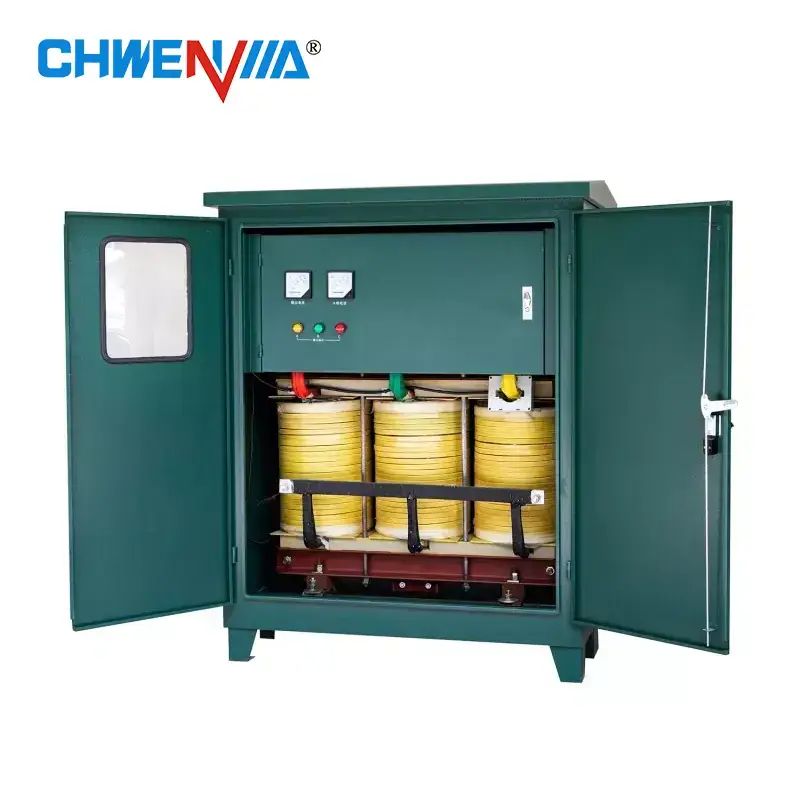
Custom voltage ratios are where catalog specs fall apart. Plenty of suppliers list “custom” as a checkbox, but only a handful will adjust winding ratios beyond a simple tap change. The difference shows up fast: ask for a 480V to 67V isolation transformer and some vendors will point you to a 70V unit and call it close. Others will pull up a core loss curve and start calculating whether your load actually tolerates ±2% at full draw.
The serious shops treat non-standard ratios as an engineering problem, not a sales line item. That means running magnetic simulations for your specific input range, choosing the lamination stack before the wire gauge, and sometimes using partial turns or gap adjustments to hit an awkward number. Expect a back-and-forth about duty cycle, ambient temperature, and inrush current—details that make a real difference when the output is not a round number.
Cost and lead time also split the market. A small tweak on an existing core might add only 10% to the price, but a genuinely new ratio can double or triple it, especially if it requires prototype testing and a custom bobbin. Minimum orders are often lower than you would think, sometimes just one or two units, but the test report you receive will tell you a lot about who actually built the thing and who just relabeled a stock design.
Lead Times and MOQs: Hidden Differences Among Distributors
Every distributor claims fast shipping and flexible order quantities, but the real story lives in the fine print. One supplier might quote a three-day lead time for standard parts, yet silently push that to two weeks for anything outside their top twenty SKUs. Another advertises a low minimum order quantity, then tacks on steep per-unit penalties for orders that dip below an unspoken threshold. These discrepancies rarely surface in a glossy catalog or a polished sales call.
The gap becomes clearer when you ask for specifics. A distributor carrying deep local stock can often ship same-day for common connectors, but their MOQ for custom-assembled cable sets might climb into the hundreds. Meanwhile, a competitor with a lean, centralized warehouse may handle small custom orders gracefully, yet require ten business days just to pick and pack a single reel of wire. Neither approach is inherently better, but the wrong assumption can stall a production line.
Savvy buyers learn to probe beyond the headline numbers. Request written lead times for the exact part numbers you plan to order, not just the product family. Ask how MOQs shift when you bundle multiple items or schedule recurring deliveries. A distributor that hesitates to put these details in writing is often revealing the hidden friction you will face later. The difference between a smooth project and a series of emergency air shipments often comes down to these unglamorous, easy-to-overlook terms.
Thermal Management Innovations from Selected Manufacturers
Rather than chasing a single breakthrough, several power electronics suppliers have quietly shifted toward co-designing thermal paths with their packaging teams. Infineon’s latest EconoDUAL modules, for instance, pair silver-sintered die attach with an optimized copper baseplate that pulls heat away from the IGBT edges where stress concentrates. The result is less thermal impedance without adding bulk, which matters more in compact drives than any headline-grabbing metric.
On the silicon carbide side, Wolfspeed has focused on reducing the number of material interfaces inside the module. By using a direct bonded copper substrate with a thinner ceramic layer and integrating temperature sensors closer to the junction, their newer packages let designers monitor hotspot formation in real time. That kind of feedback has allowed inverter makers to push closer to the chip’s actual thermal limit instead of relying on conservative derating curves.
Meanwhile, smaller specialty manufacturers are exploring microchannel cold plates built with additive manufacturing. Rather than milling straight channels, these companies print serpentine paths that follow the measured heat map of a specific module or processor. The approach raises pressure drop only slightly but can lower peak case temperatures by double digits compared with conventional liquid cooling plates, making it attractive for high-density server and traction applications.
Compliance Beyond CE: UL, IEC, and Custom Standards
CE marking rarely settles compliance questions outside the European Economic Area. A product that meets the Low Voltage Directive may still need UL 508A or UL 62368-1 certification in the United States, where insurers and local inspectors often refuse installation without a recognized NRTL mark. The differences show up in creepage distances, temperature ratings, and approved component lists, sometimes forcing a separate build variant or a re-evaluated bill of materials.
IEC standards can act as a starting point, not a finish line. Many national schemes build on IEC 62368, IEC 61010, or IEC 60950, but each country layers its own deviations. Canada adds CSA requirements onto IEC-based tests. South Korea, Australia, and Brazil apply national differences that can demand retesting for mains frequency, altitude, or tropical humidity. Relying on an IEC report as final can create expensive surprises at import clearance.
Custom standards fill the gaps where off-the-shelf categories fail. Industrial machinery with safety PLCs, laboratory equipment exposed to flammable gases, or systems blending medical and IT functions often need a test plan built around ISO/IEC 17025 methods and a product-specific risk assessment. Defining acceptance criteria early with the customer or local authority avoids the late-stage redesigns that burn months of schedule and budget.
After-Sales Service Networks Across Chinese Provinces
The layout of after-sales service networks across Chinese provinces often mirrors the uneven pulse of regional economic development, yet the real story lies in how local teams improvise. In the Pearl River Delta, for instance, dense industrial clustering allows technicians to hop between factories within a single afternoon, while in the inland west, a single service center might cover a region the size of a small European country, relying on long-haul couriers and pre-positioned spare parts. The contrast is not just logistical; it shapes how customers experience brand reliability, turning infrastructure into a silent promise that your machine won't sit idle for long.
Provincial differences also push companies to abandon one-size-fits-all repair strategies. Coastal provinces with high humidity demand corrosion-resistant toolkits and more frequent preventive visits, whereas plateau areas like Qinghai require vehicle modifications and altitude-trained engineers. Some brands have quietly started rotating their best troubleshooters between provinces not just to transfer skills, but to break the mental habit of assuming that a fault common in Guangdong must be rare in Heilongjiang. This cross-pollination of field notes has become a quiet competitive edge, as the network learns from its own edges.
Beyond the operational layer, the real texture of these networks comes from local partnerships—family-run repair shops in county towns, third-party logistics firms that know every pothole on a provincial highway, and even retired factory workers who act as informal consultants. In many regions, the official service center is just the tip of an iceberg whose submerged bulk consists of handshake agreements and decades-old relationships. That human infrastructure, unevenly distributed and impossible to standardize, is what ultimately determines whether a broken machine in Anhui gets fixed by sunset or by the end of the week.
FAQ
Several names consistently come up, including TBEA, China XD Group, and Baoding Tianwei Group. They have large production capacities and export to many regions.
Look for suppliers with ISO 9001 certification, a track record of export orders, and the ability to provide type test reports from recognized labs. Visiting the factory or hiring a third-party inspector also helps.
Most can manufacture oil-immersed, dry-type, and cast resin transformers. Voltage ratings typically range from 6 kV up to 765 kV or higher, depending on the supplier's capabilities.
For standard designs, expect 4 to 8 weeks. Custom units with unusual voltage ratios or special cooling requirements can take 12 to 20 weeks, especially during peak demand periods.
Many top manufacturers have service teams that can travel to the installation site. Some also partner with local distributors to handle warranty claims, spare parts, and routine maintenance.
Reputable suppliers design to IEC, IEEE, or ANSI standards depending on the destination market. Ask for certificates and recent test reports to confirm compliance.
Distributors often handle smaller orders, provide quicker quotes, and offer local stock for popular models. They bridge the gap between large manufacturers and overseas buyers who need lower MOQs.
Request a factory acceptance test (FAT) where the unit is tested at rated voltage and load. You or a third-party inspector can witness the test, or ask for video and detailed reports.
Conclusion
When evaluating step-up transformer manufacturers in China, the quality of core material often separates dependable suppliers from the rest. Rather than accepting generic claims about silicon steel grades, buyers should ask for batch-level core loss curves and thickness tolerances, especially for high-frequency or continuous-duty applications. Custom voltage ratios are widely available, but the practical range varies from one supplier to another. Some factories keep common winding templates on hand, while others will re-engineer insulation clearances for unusual step-up requirements at a price. Pay attention to how those requests affect lead times—distributors frequently quote shorter windows because they hold buffer stock, whereas direct manufacturers may offer lower unit costs but impose higher minimum order quantities.
Thermal management is another area where selected Chinese manufacturers have moved beyond basic natural air cooling. Improved fin geometries, forced-air tunnels, and oil-immersed designs now appear even in mid-sized units, which can shift the real continuous power rating. Compliance should not stop at CE marking; asking for UL component recognition, IEC test summaries, or customer-specific dielectric and partial discharge reports often reveals whether a supplier is truly export-ready. Finally, after-sales service networks differ sharply by province—some suppliers maintain regional repair hubs in Guangdong, Jiangsu, or Zhejiang, while others rely on third-party contractors. Before committing, ask how field faults are handled in your destination market and whether spare parts can be dispatched within days rather than weeks.
Contact Us
Contact Person: Mr. Jiang
Email: [email protected]
Tel/WhatsApp: +86-15057775503
Website: https://www.avrfactory.com/