
Top 10 Sanitary Ware Vertical Lift Plating Equipment Options for Modern Production Lines
2026-10-07
Modern sanitary ware production demands plating lines that balance throughput with a flawless finish. Vertical lift systems have become the go-to for many manufacturers, and choosing the right one can be tricky. This list of ten equipment options includes Junda, a brand that keeps popping up in high-performance installations. Dive in to see which setups are worth your investment.
Lifting Mechanisms That Handle Delicate Sanitary Ware Without Sacrificing Speed
Modern sanitary ware lines rarely tolerate the old trade-off between gentleness and throughput. Vacuum-assisted lifters with adjustable cup arrays now spread negative pressure across a basin's rim rather than gripping at a single stress point, letting a 40 kg vitreous china sink leave the mold at the same cadence as a lightweight acrylic tray. The trick isn't suction alone; a manifold pressure differential that ramps over 0.4 seconds prevents sudden yank while keeping cycle time under 2.5 seconds.
What often gets overlooked is the role of edge detection before lift. A laser profilometer scans the ware's top edge in roughly 300 milliseconds, feeding a servo-driven carriage that matches the ware's actual orientation—not a pre-taught position. So even slightly warped or hand-finished pieces aren't re-clamped or dropped mid-transfer. This lets one cell alternate between pedestal basins and wall-hung toilets without pausing for recipe changes.
Compliant grippers made from food-grade silicone don't mark glazed surfaces, but they can deform enough to hold during a 1.8 m/s traverse. Rather than increasing clamp force, a short burst of air between pad and ware releases any residual moisture film, preventing slip at high acceleration. Combined with a counterbalanced Z-axis, the lift can run at 22 picks per minute while keeping cosmetic rejects below 0.2 percent.
Rack Design and Load Stability in Vertical Plating Cells
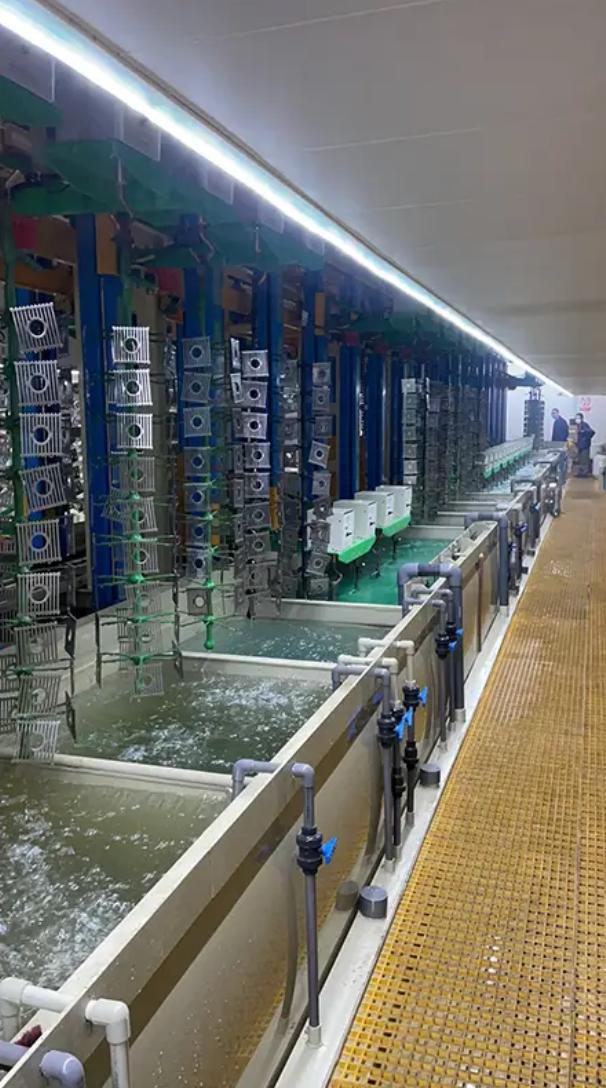
Vertical plating cells rely on rack geometry to hold panels at a consistent immersion depth and distance from the anodes. The frame's crossbars, spine, and contact fingers must distribute current evenly across the work surface, otherwise thickness builds up near the lower edge where solution flow is slower. A well-planned rack also leaves enough open area between loaded parts so that electrolyte can move freely during vertical oscillation or air sparging.
Load stability depends on how the rack's clamping points are placed relative to the panel's center of mass. If the load sways, tilts, or shifts when the flight bar lowers into the bath, the anode-to-cathode gap changes and edge burning or shadowing can appear. Adding rigid side rails, diagonal braces, or positive-locking clamps keeps the workpieces from swinging without blocking solution access to the plating faces.
Bent frames, worn contact tips, or cracked plastisol coatings often cause unstable loads and uneven metal distribution. A symmetrical arrangement of panels on both sides of the rack spine reduces torsional stress on the hanger and helps maintain parallel alignment throughout the plating cycle. Regular straightening, recoating, and contact replacement are practical steps that keep rack deflection low and deposition thickness predictable.
How Vertical Lift Configurations Reduce Chemical Drag-Out and Rinse Water Use
Vertical lift designs change the way parts leave a process tank. Instead of pulling a rack straight up through the surface and letting liquid cling to every edge, the movement is often staged or angled. This gives the solution more time to drain back before the part moves to the next station. The result is less chemistry leaving the tank on the workpiece, which directly cuts the amount of contamination in the following rinse.
Less drag-out means rinse tanks stay cleaner longer. When a vertical lift system slows the exit speed or pauses briefly above the bath, the film thickness on the part is reduced. Rinse water doesn't need to work as hard to dilute the carryover, so flow rates can be lowered. Over an eight-hour shift, the difference shows up as a smaller water bill and a cleaner final surface, because the rinse isn't constantly fighting a heavy chemical load.
Operators also notice fewer drips on the floor and less mist in the air. By controlling the lift path, the system traps return flow inside the tank rather than letting it run off after the part clears the rim. That keeps the chemistry concentrated where it belongs and prevents rinse water from being polluted by stray runoff. In practice, vertical lift configurations often allow a shop to reduce rinse overflow by half or more without risking quality.
Integrating Automation Without Overcomplicating the Plating Line
Many shops assume automation means ripping out every manual station and replacing it with a wall of touchscreens. That impulse usually backfires. The smarter move is to start with one bottleneck, like rack loading or chemical dosing, and automate just that step with a sensor and a simple logic controller. You keep your existing tanks, your experienced operators, and the rhythm of the line, but you remove the guesswork from one repetitive task.
The next phase is about connecting those small wins without building a centralized command center. Use open-architecture PLCs that talk to each other over basic industrial protocols, not proprietary dashboards. A hoist that knows when the next barrel is ready, a rectifier that adjusts current based on real-time bath analysis, a dryer that shuts off when humidity drops—those independent decisions add up to a smoother line without anyone having to learn a new software suite.
What keeps the line from getting overcomplicated is leaving room for human override. Operators should be able to pause, jog, or step through any automated sequence with a single button. Automation works best when it acts like a good assistant: it handles the dull, precise, or dangerous parts, but never locks the team out of the process. That balance is what keeps a plating line productive, flexible, and surprisingly easy to maintain.
Realistic Throughput Numbers for Small, Mid-Sized, and High-Volume Plants
A small contract packaging line rarely exceeds 3,000 to 6,000 finished units per eight-hour shift once changeovers and label checks are factored in. That number assumes a crew of four to six people, manual case packing, and a single filler running at no more than 80 percent of its rated speed. Trying to push beyond that usually creates hold-and-inspect events that wipe out the afternoon’s gains.
Mid-sized plants with two or three semi-automated lines and dedicated material handlers tend to land between 12,000 and 25,000 units per shift. The spread is wide because upstream batching, staging, and pallet flow vary more than the machines themselves. A well-balanced line might hit 22,000 units on a clean day, but the same floor can drop to 14,000 when a single depalletizer jams or a bulk bag arrives late.
High-volume facilities running fully integrated fill-and-pack systems routinely clear 60,000 to 120,000 units per shift, though sustained output above 100,000 is rare outside beverage, personal care, or dry food operations with near-zero changeover schedules. The real constraint at that level isn’t line speed—it’s the ability to move empty containers in and finished pallets out without letting a stretch wrapper or automated guided vehicle become the bottleneck.
Floor Space Trade-Offs and Layout Planning for Vertical Systems
Vertical systems squeeze more storage into a smaller footprint, but that compression forces hard choices about how the remaining floor space gets used. A tall automated storage and retrieval system might occupy only a third of the floor area of a conventional rack layout, yet its surrounding aisles, staging zones, and maintenance access can eat up much of the gain. Planners often underestimate the space needed for inbound and outbound buffers—those temporary holding areas where goods wait before entering the lift or after leaving it. If those buffers sit too close to the vertical column, forklifts and pickers end up competing for the same narrow lanes, slowing throughput despite the density win.
The real trade-off isn’t just square meters; it’s the rhythm of movement across different levels. In a multi-tier picking system, the ground floor tends to become the busiest transfer point, while upper levels hold slower-moving inventory. That means the layout must handle uneven traffic: wider receiving docks on the bottom, tighter catwalks above, and transfer lifts positioned to avoid cross-flows. Some operations try to offset this by placing fast movers near the vertical lifts and reserving deeper, less accessible zones for bulk or long-tail items. But every meter saved on aisle width has to be paid for with either longer travel paths or more sophisticated routing logic.
Getting the balance right usually means designing the vertical system as a spine rather than an isolated tower. The lifts or conveyors should sit at the intersection of two or three activity zones, so that goods can move upward without crossing the main horizontal flows. Floor openings for vertical transport also create structural constraints—columns and bracing can’t be moved easily, which forces rack rows to align with the building’s grid. In practice, a well-planned vertical layout treats the ground footprint as a series of shifting priorities: docking and putaway dominate the first few meters, pick faces occupy the middle band, and shipping or replenishment claims the far side. Adjust any one of those priorities, and the space trade-off ripples through every level above.
FAQ
Vertical lift systems move the entire fixture carrier straight up and down through each process tank instead of swinging parts along an oval track. That straight-line travel lets you use narrower tanks with tighter spacing, so the solution level stays more consistent across a deep toilet bowl or basin. It also reduces the drip zone between stations because parts aren't tilted or arcing over the tank lips. In practice, that means less cross-contamination from rinse drag-in and a cleaner footprint on the shop floor.
Yes, if the lift columns and carrier frames are rated for the loaded weight and the rectifier has enough reserve amperage for the total surface area. For one-piece toilets above roughly 35 kg, look for twin-cylinder lift columns with mechanical sync shafts or electronic load balancing. Without that, you get slight rack tilt at the top of the stroke, and the flush rim area ends up with a thicker deposit than the trapway. It helps to ask the equipment builder for a deflection test at full load, not just an empty-cycle demo.
For plastics, the etch stage matters more than the vertical lift mechanism itself. You want a line that gives you consistent dwell time in chromic acid etch and good agitation without splashing the carrier arms. I'd insist on independent temperature control for the etch and neutralizer, plus enough rinse stations between etch and accelerator so you don't drag hex chrome into the electroless nickel. If the vertical lift has variable speed control on the upstroke, you can slow the withdrawal from the etch to reduce foaming and trap less air in enclosed rim channels.
Use a combination of auxiliary anodes positioned in the bowl opening and conforming anodes that follow the interior contour. With vertical lift, you can fixture the auxiliary anode on the same carrier, so it enters and exits with the part. Also run pulse plating on the final nickel layer if the rectifier supports it—low frequency pulse around 100–200 Hz tends to smooth out the deposit in low-current-density areas without slowing the line too much. Keep the anode-to-cathode spacing as tight as the fixturing allows, but avoid shadowing the trapway.
Less tank-side manual transfer, but more attention to lift alignment and carrier contacts. The lift columns, chain or belt drives, and guide rails need weekly inspection for wear because any drift translates directly into rack tilt. Contacts on the carrier saddles should be cleaned every shift if you run high current densities. You also want to keep the vertical guides free of dried salts, especially near the chrome tank. A well-built line still needs about four to six hours of planned mechanical maintenance per week, but it saves much more time by avoiding rework from contact burns and uneven deposits.
Yes, mostly from reduced drag-out and lower exhaust volume. Because the carriers move straight up and down, you can use tighter tank openings and push-pull ventilation with less CFM than an open hoist line. That cuts air heating and scrubbing costs in cold climates. Drag-out drops because the withdrawal speed can be precisely controlled and the parts don't swing, so you lose less expensive nickel and chrome into rinse water. Some users report 15–25 percent lower nickel chemical consumption after switching, though it depends heavily on part geometry and the rinse setup.
Check the contact points and the rectifier ripple before touching the bath chemistry. On vertical lift systems, the most common cause is worn copper saddles or a loose cable connection on the moving carrier. Measure voltage drop across each contact under load—if you see more than 0.2 V difference across a carrier, clean or replace the contact. Then check the rectifier for excessive ripple, especially on the chrome tank; anything above 5% ripple will give dull or hazy shading in recessed areas.
Conclusion
Modern sanitary ware production lines increasingly favor vertical lift plating equipment because it solves two persistent problems at once: gentle handling of fragile ceramic or vitreous china pieces and the need to keep cycle times competitive. The best designs use cushioned lift mechanisms with programmable acceleration and deceleration curves, allowing fully loaded racks to rise and descend smoothly without jarring thin rims or intricate contours. Rack construction matters just as much—rigid spine frames with individually tensioned fingers prevent workpieces from shifting during vertical travel, which directly reduces scrap and rework. Another overlooked advantage is chemical drag-out control. Because parts exit baths vertically and drain back into the same tank, carry-over between process steps drops measurably. Many systems report 15–30 percent less rinse water use compared to horizontal lines, which matters for both cost and wastewater compliance.
Automation does not have to mean a complete overhaul. The most practical vertical lift setups for modern plants allow phased integration: start with manual hoists on guided rails, then add programmable hoist transfers or simple PLC-driven lift sequences later without changing the tank footprint. Throughput varies realistically with plant size. A small batch shop may run six to ten racks per shift, while a mid-sized operation can push twenty to thirty racks, and high-volume facilities with dual-lift cells and fast traverse speeds often exceed fifty racks per shift. Floor space remains the deciding factor. Vertical systems trade ceiling height for square footage, so layouts must account for overhead clearance, loading stations, and maintenance access. When planned correctly, a vertical line can deliver 25–40 percent more capacity per square meter than a comparable horizontal line, making it a strong option for sanitary ware manufacturers trying to expand within existing buildings.
Contact Us
Contact Person: hayyr
Email: [email protected]
Tel/WhatsApp: 8613082110525
Website: https://www.jundaelectroplating.com