

How Do I Choose a Nebulizer Set That Actually Works for Patients and Budgets?
2025-12-12
I learned early that a Nebulizer Set only performs as well as its smallest parts—cup geometry, jet design, strap comfort, even how the tubing grips a barb. After trialing several vendors, I started using Rito kits in a few rooms and saw fewer restarts and quicker sessions. That experience reshaped how I evaluate a Nebulizer Set: not by flashy claims, but by repeatable deposition, low residuals, and calmer patients. In this piece I’ll walk through the questions I ask before I buy a Nebulizer Set, why the details matter, and how a well-spec’d Nebulizer Set quietly improves throughput without cutting clinical corners.
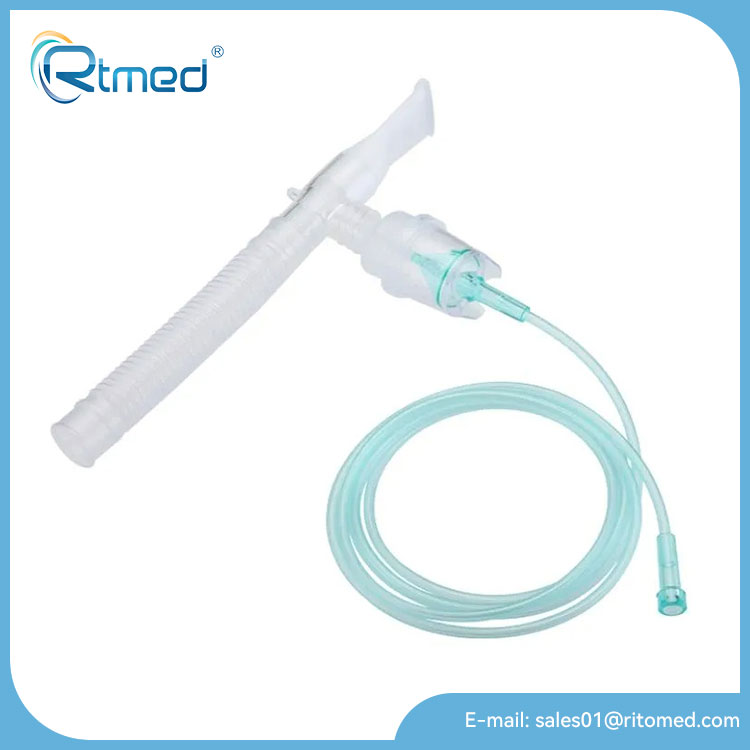
What should I check first when comparing a Nebulizer Set?
- Particle size I can trust: I target MMAD around 2–5 μm for lower-airway delivery, prioritizing consistency over one perfect lab number.
- Fill volume and residuals: Cups that handle 2–8 ml and leave ≤0.5 ml reduce wastage and keep dosing predictable.
- Breath comfort: Soft-edge masks and well-vented mouthpieces cut jaw fatigue; true pediatric sizing is non-negotiable.
- Flow compatibility: Stable aerosol at 4–8 L/min (what my compressors actually deliver) beats specs I can’t reproduce.
- Connector reliability: If tubing slips under twist and pull, every other advantage disappears.
Why does cup geometry and jet design change real outcomes?
With the right geometry, the Nebulizer Set reaches the same therapeutic effect in less time and with less solution, which translates to happier patients and faster room turnover.
How do materials influence durability and clarity?
- Medical-grade PP/PC: Clear walls let me verify fill level and foaming at a glance; haze after a few cleanings is a red flag.
- Latex-free elastomers: Straps and seals need grip without bite; allergy risk stays off the table.
- Resin traceability: Even for single-use, consistent resin equals consistent aerosol output across lots.
What’s inside a complete kit and how do I evaluate each part?
| Component | What I Look For | Recommended Material | Single-Use or Reusable | Packaging Notes |
|---|---|---|---|---|
| Nebulizer Cup | Low residual, stable MMAD, accurate markings | PP/PC, clear | Single-use common; reusable if validated | Individual sterile pouch, lot code |
| Mask or Mouthpiece | Seal without over-tightening; vent design | Latex-free elastomer + PP | Single-use typical | Clear Adult/Pediatric size label |
| Oxygen/Air Tubing | Kink resistance; firm barb grip | Medical-grade PVC or TPE | Single-use | Coil-packed to avoid memory bends |
| Filters (if included) | Low backpressure; intuitive placement | Microfibrous media | Replace per session/schedule | Change indicators or clear IFU |
Where do cost savings show up without compromising care?
My costs fell in three places: shorter treatment windows, fewer leak-driven restarts, and less wastage from high-residual cups. A consistent Nebulizer Set also standardizes sessions, which trims onboarding time for new staff and reduces documentation errors.
Can one kit serve different patient groups well?
- Adults with COPD/asthma: Mouthpiece first for deposition; masks for poor coordination.
- Pediatrics: True child sizing with gentle straps; low-odor materials improve compliance.
- Home care vs. clinic: Color-coded parts and clear IFUs cut caregiver confusion at home.
How do I verify performance beyond a brochure?
- Run side-by-side at your real compressor flow.
- Time to empty; weigh residual volume.
- Log patient comfort and perceived inhalation resistance.
- After five deliberate re-attachments, inspect connectors for wear.
What about cleaning, disposal, and infection control in the real world?
For single-use workflows, I want sterile packs, lot traceability, and clear disposal guidance. For reusable cups, I need validated agents, cycle counts, and temperature limits in the IFU. Labeled storage prevents mixing components from different lots within the same Nebulizer Set.
How does Rito fit my purchasing criteria without hype?
In my pilot, Rito kits delivered practical upgrades: crisp scale lines that didn’t fade, tubing that resisted collapse under bends, and masks that sealed without overtightening. Those details made the Nebulizer Set feel invisible during therapy—the device stepped aside so the medication could do its job.
Which quick checklist helps me sign a PO with confidence?
- MMAD verified at my compressor’s flow band
- Residual volume measured and acceptable
- Latex-free, clearly size-labeled masks
- Barb/tubing interface passes pull-and-twist tests
- Lot traceability and intact sterile packs
- IFU tailored to home, clinic, or ward use
What final advice would I give a buyer in a hurry?
Don’t chase the lowest unit price if it adds five minutes to every session. The right Nebulizer Set pays for itself in throughput and fewer complaints. If you need a simple first step, evaluate a Rito sample lot against your baseline using the tests above and let your logs—not logos—make the decision.
Ready to compare options with real samples and straight pricing?
If you want side-by-side data, kit photos, or a quick trial for your team, tell me about your patient mix and compressor setup. I’ll share a one-page checklist you can run in under an hour. When you’re ready, contact us for quotes, specifications, and evaluation units of a Nebulizer Set that fits your workflow.