

What Safety Features Should You Check Before Using a Disposable Infusion Pump
2026-07-29
When a clinician reaches for a Disposable Infusion Pump, the immediate focus is often on flow rate settings and drug compatibility. Yet the real cornerstone of patient outcomes lies in the device’s built‑in safety architecture. For medical teams relying on Greatcare elastomeric and mechanical disposable systems, understanding which safety features to verify before every infusion is not a checklist item—it is a clinical mandate. A single overlooked valve or misread pressure indicator can turn a routine therapy into a critical event.
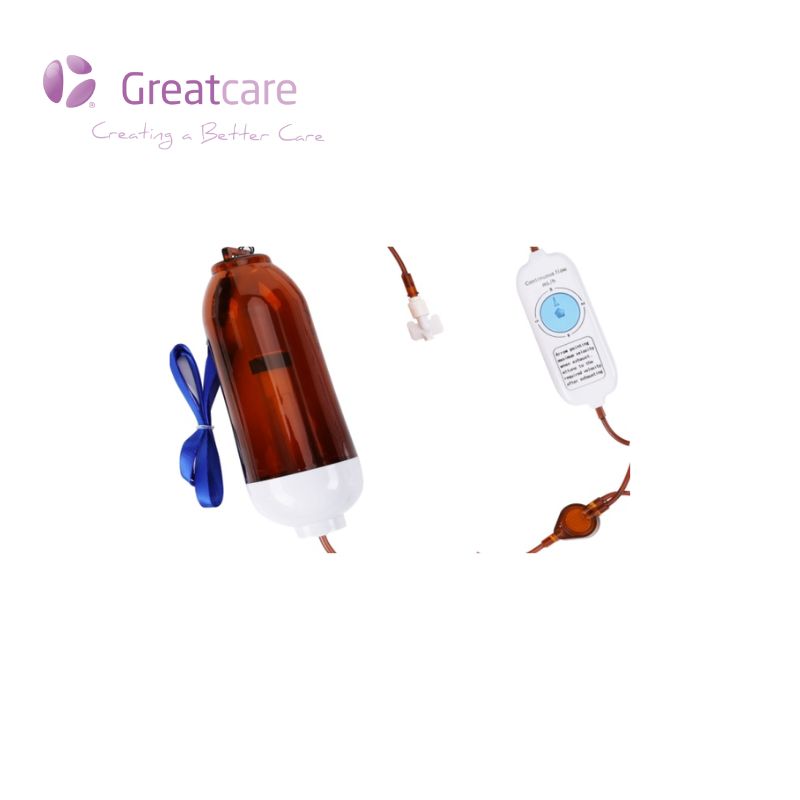
Core Safety Features to Verify Pre‑Use
Every Disposable Infusion Pump contains multiple layers of protection. The table below summarizes the essential safety checks, their clinical purpose, and the practical action required at the bedside.
| Safety Feature | Clinical Purpose | Bedside Action |
|---|---|---|
| Flow Restrictor Integrity | Prevents free‑flow and bolus dosing | Inspect the glass or ceramic restrictor for cracks; confirm it is seated within the cassette |
| Occlusion Pressure Threshold | Triggers alarm or visual indicator when downstream resistance exceeds 10–15 psi | Check the pump’s pressure‑response label; test with a manual syringe before connecting to patient |
| Air Elimination Filter | Traps micro‑bubbles >0.2 µm that can cause venous air embolism | Ensure the filter is wetted (no dry spots); verify the vent port is open to atmosphere |
| Anti‑Siphon Valve | Prevents retrograde flow when the reservoir is compressed unintentionally | Gently compress the reservoir—the valve should close immediately and fully |
| Patient‑End Connector Lock | Reduces risk of accidental disconnection or tubing misconnection | Twist the Luer‑lock until an audible click is heard; tug lightly to confirm resistance |
| Drug Labeling Zone | Allows clear identification of infusate, concentration, and expiry | Write directly on the designated matte area—avoid covering the flow window |
| Reservoir Fill Line | Prevents overfill (>100% capacity) that alters elastomeric pressure | Fill only to the marked line; use a graduated syringe for accurate volume |
Beyond the Label: Active vs. Passive Safety
Safety in a Disposable Infusion Pump can be passive (mechanical failsafes) or active (user‑triggered checks). Greatcare designs both layers into every unit. Passive safety includes the fixed‑orifice flow restrictor, which cannot be adjusted by the user—eliminating programming errors. Active safety, however, depends entirely on the clinician’s pre‑use inspection. For example, checking that the protective cap remains intact until connection verifies sterility, while peeling back the backing on the adhesive patch confirms the pump will stay secured to the patient’s arm during ambulation.
5‑Step Pre‑Use Safety Protocol (Clinical Standard)
-
Visual Inspection – Hold the pump against a light source. Look for particulate matter, cracks in the housing, or deformation of the elastomeric membrane.
-
Priming Check – Open the clamp and allow 2–3 mL of fluid to expel into a waste container. Observe a steady, drip‑free stream—intermittent sputtering indicates a partial occlusion.
-
Pressure Response Test – Occlude the patient line with a finger; the reservoir should bulge slightly, and the visible pressure gauge (if present) should move within 5 seconds.
-
Tubing Integrity – Run a gloved finger along the entire length—kinks, twists, or sharp bends >45° are unacceptable.
-
Expiry & Storage Confirmation – Confirm the sterile barrier remains intact and the use‑by date has not passed (storage temperature 15–25°C is typical for Greatcare pumps).
Frequently Asked Questions About Disposable Infusion Pump Safety
Q1: What is the most common safety failure in a Disposable Infusion Pump, and how can I detect it before connecting to the patient?
A1: The most frequent failure is partial occlusion at the flow restrictor inlet, often caused by precipitated drug crystals or silicone debris from the manufacturing process. Detection requires a two‑step method: first, perform the “drop test” by holding the pump vertically and observing the drip rate from the patient end—a healthy Disposable Infusion Pump produces a consistent drop every 2–3 seconds at standard 100 mL/hr settings. Second, attach a 3‑mL syringe to the patient connector and withdraw gently; if you feel resistance greater than 2–3 mL of pull, the restrictor is likely compromised. In that case, discard the pump immediately and open a new Greatcare unit—never attempt to flush or clear the restrictor with a stylet, as this damages the precision orifice.
Q2: Does the presence of an air elimination filter guarantee that my Disposable Infusion Pump is safe for intravenous use without additional priming?
A2: No. The hydrophobic air filter removes microscopic air bubbles, but it does not remove macroscopic air pockets that can form during priming. If you attach the pump without fully wetting the filter, the air‑locking effect can stop flow entirely—even though the filter is technically functional. The correct safety procedure is: prime the line until fluid emerges from the patient connector, then hold the pump with the filter port facing upward and tap the housing gently to dislodge trapped air, allowing it to escape through the vent. Greatcare filters are rated for 0.2‑µm bacterial retention, but they are not a substitute for visual confirmation that the entire fluid path is liquid‑filled. Always run at least 5 mL of infusate through the line before patient connection.
Q3: How do I know if the occlusion alarm on a Disposable Infusion Pump is actually working, since most disposable pumps do not have electronic sensors?
A3: You are correct—most Disposable Infusion Pump systems rely on mechanical pressure indicators rather than battery‑powered alarms. For Greatcare mechanical pumps, the occlusion indicator is a visible red stripe on the reservoir that appears when internal pressure exceeds 12 psi. To test this function pre‑use, occlude the patient line completely with a hemostat, then gently squeeze the reservoir. Within 15–20 seconds, the red stripe should become clearly visible through the transparent housing. If the stripe does not appear, the pressure‑sensing membrane may be stiff or defective—do not use that unit. For clinical workflows requiring audible alerts, pair the disposable pump with an external flow monitor (sold separately by Greatcare), which clips onto the tubing and emits a tone when flow stops for more than 30 seconds.
Documentation and Traceability
A safe Disposable Infusion Pump is a documented one. Greatcare prints a unique lot number and manufacturing date on each primary package. Record these details in the patient’s electronic medical record alongside the infusion start time. This practice supports root‑cause analysis should any adverse event occur, and it fulfills the traceability requirements of ISO 80369‑7 for medical device vigilance.
Final Clinical Judgment
Safety features are only as effective as the clinician’s discipline in checking them. The Disposable Infusion Pump has replaced many complex electronic devices in ambulatory and home‑care settings precisely because it simplifies therapy—but simplification does not mean abdication of responsibility. Every shift change, every new bag of medication, and every patient transfer demands a fresh visual and functional check. Greatcare engineering provides the tools; your expertise provides the safeguard.
Contact Us – If you have questions about selecting the right Disposable Infusion Pump for your department, or if you need in‑service training materials on safety checks, reach out to our clinical support team directly. Visit our website to request a demo kit, download the latest safety checklist poster, or speak with a Greatcare application specialist. We respond to all inquiries within 4 business hours and offer complimentary 30‑minute virtual walkthroughs for new users. Your patients’ safety starts with a conversation—let’s start yours today.